
7AI executes the workflows your team defines. When a real attack deviates from what your Skills were built to find, teams start looking for an alternative that investigates dynamically instead of following a predefined path.


















Real attacks do not follow playbooks. Your investigation should not either.
A Skills-based workflow finds what it was written to find. Qevlar AI builds its investigation plan from what it actually discovers in your environment, pivoting dynamically across your stack. No predefined path. Just the evidence, followed to its end.
Knowledge that sticks across every investigation
Custom Skills require someone to write them, maintain them, and update them when the environment changes. Qevlar AI detects recurring patterns on its own and surfaces new context items for analyst validation. Your team controls what gets applied without authoring every rule from scratch.
No LLM improvisation, just the evidence
Skills-based platforms define the investigation before it starts. Qevlar AI builds the investigation plan from what it finds, using a graph orchestrator that keeps LLMs scoped to specific, bounded tasks. The same inputs produce the same result. No variance, no surprises.
Every outcome closes the loop
Finding the threat is step one. Qevlar AI takes the rest: tuning detection rules, flagging coverage gaps, and feeding hunt findings back into your detection layer automatically. The SOC gets stronger from the work it was already doing.
Goes beyond alert artifacts to pivot across your entire connected stack

Advanced. Investigations expand beyond the alert boundary: multi-source pivoting, detection of related IOCs, uncovering authentication anomalies, and revealing the full attack scope.

Investigation is scoped to the artifacts in the alert. No documented capability for pivoting across external tools to extend threat scope.
Automatically links related alerts into a single incident story
Automatically correlates related malicious activity into a single, prioritized investigation, across any source in your stack.

Alerts are treated as separate events by default. Automatic grouping into multi-stage incidents is not available.
Prevents inconsistent or hallucinated conclusions
Graph orchestration. A proprietary graph-based engine plans the full investigation and adapts dynamically. LLMs handle only narrowly scoped tasks. Same inputs produce the same plan.
The investigation pipeline relies on LLM output. Edge-case inputs can produce variable results.
Every step, every source, every decision visible to analysts
Transparent. Every stage is visible: each observable analyzed, each source queried, each step taken. Complete traceability from raw alert to final verdict.
Investigation packages include full evidence and reasoning, available for analyst review.
Builds context to adapt investigations to your environment
Yes, with pre-deployment testing. Qevlar AI accumulates and proactively builds context. Analysts can test the impact of new context before it affects live investigations.
Custom Skills support context onboarding. Pre-deployment testing against historical cases is not available.
The platform proposes new context based on what it learns
Yes. Suggests new context items based on recurring patterns surfaced across investigations. Routed to your team for review before being applied.
Custom Skills support context onboarding. Pre-deployment testing against historical cases is not available.
Factors in past alerts, incidents, and ITSM tickets
Yes. Factors in past investigation outcomes and pulls historical tickets directly from ITSM for additional context.
Not available.
Rule tuning and coverage gap identification
Emerging capability. Qevlar AI identifies noisy rules and coverage gaps, with upcoming capabilities to suggest rule tuning and recommend new detections across SIEM, EDR, and cloud stack.
Detection rule performance is analyzed to surface and reduce false positives.
Connects security incidents with vulnerability management to prioritize risk
Emerging capability. Connects CVEs to active exploitation and security incidents. Proactively hunts for CVEs and identifies asset owners so teams can act faster.
Not available.
SaaS + BYOC. UK, US, and EU regional hosting available. Your data stays where compliance requires.
SaaS-only delivery. No self-hosted deployment option.
Rule tuning and coverage gap identification
1,500+ deployments. Adopted by Fortune Global 500 companies and leading MSSPs across 10 countries.
Production deployments are limited. Platform targets enterprise accounts with limited public case evidence.
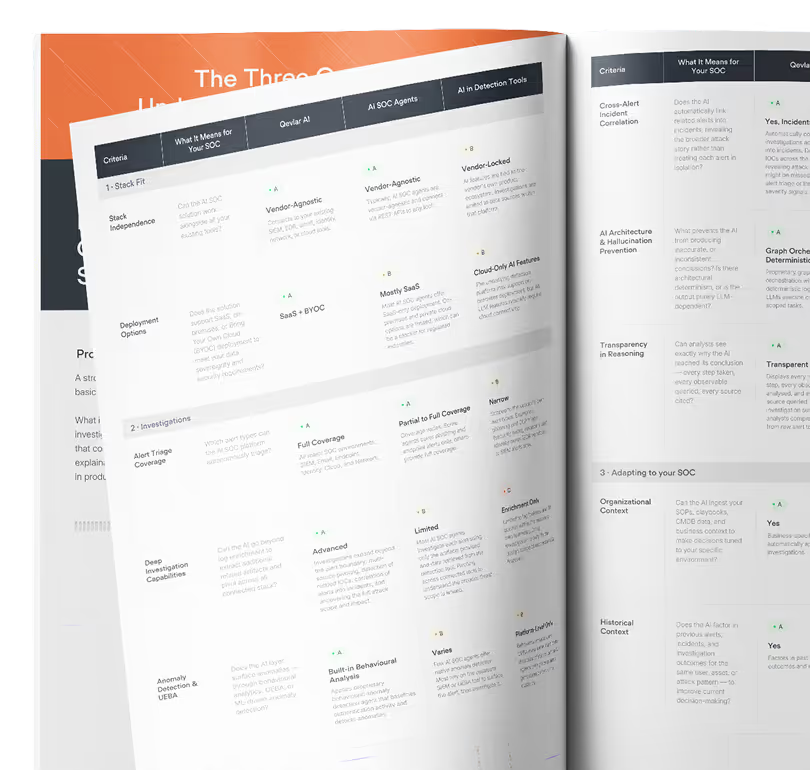
This page covers one comparison. The guide covers all of them. We compared every major approach to AI-driven security operations across 18 criteria and 6 dimensions. Free to download.
Your SOC, powered by Qevlar AI
100%
of alerts investigated
across your entire security stack
9%
faster MTTR from triage to containment
80%
less manual work
for SOC analysts
2x
SOC capacity
with the same team
See Qevlar AI in action
Book a 30-minute demo with our team. See how Qevlar AI deeply investigates and makes your defenses stronger with each alert.
From the AI SOC Frontline

Three Ways to Prove AI ROI for MSSPs
The 3 ROI drivers that leadership teams care about when evaluating AI investments, with examples from European and US-based SOCs.

AI SOC Solutions Compared: A Buyer's Guide for 2026
There are 3 ways to put AI to work in your SOC in 2026. We put them side by side against 18 criteria, so you can identify which fits yours best and save weeks of research.
The SOC Survival Guide for the Frontier Model Era
This guide helps you identify the risks earlier and understand what it takes to close them.