When a vulnerability is disclosed, patching and investigation solve different problems. A patch can close the exposure. It does not establish whether the environment was already exploited.
This anonymized customer case shows how a Qevlar Watcher monitored PHP workloads affected by PHP2Shell, adapted its detection as evidence changed and passed exploitation signals to investigation.
The customer record
| Watchers | What the record shows |
|---|---|
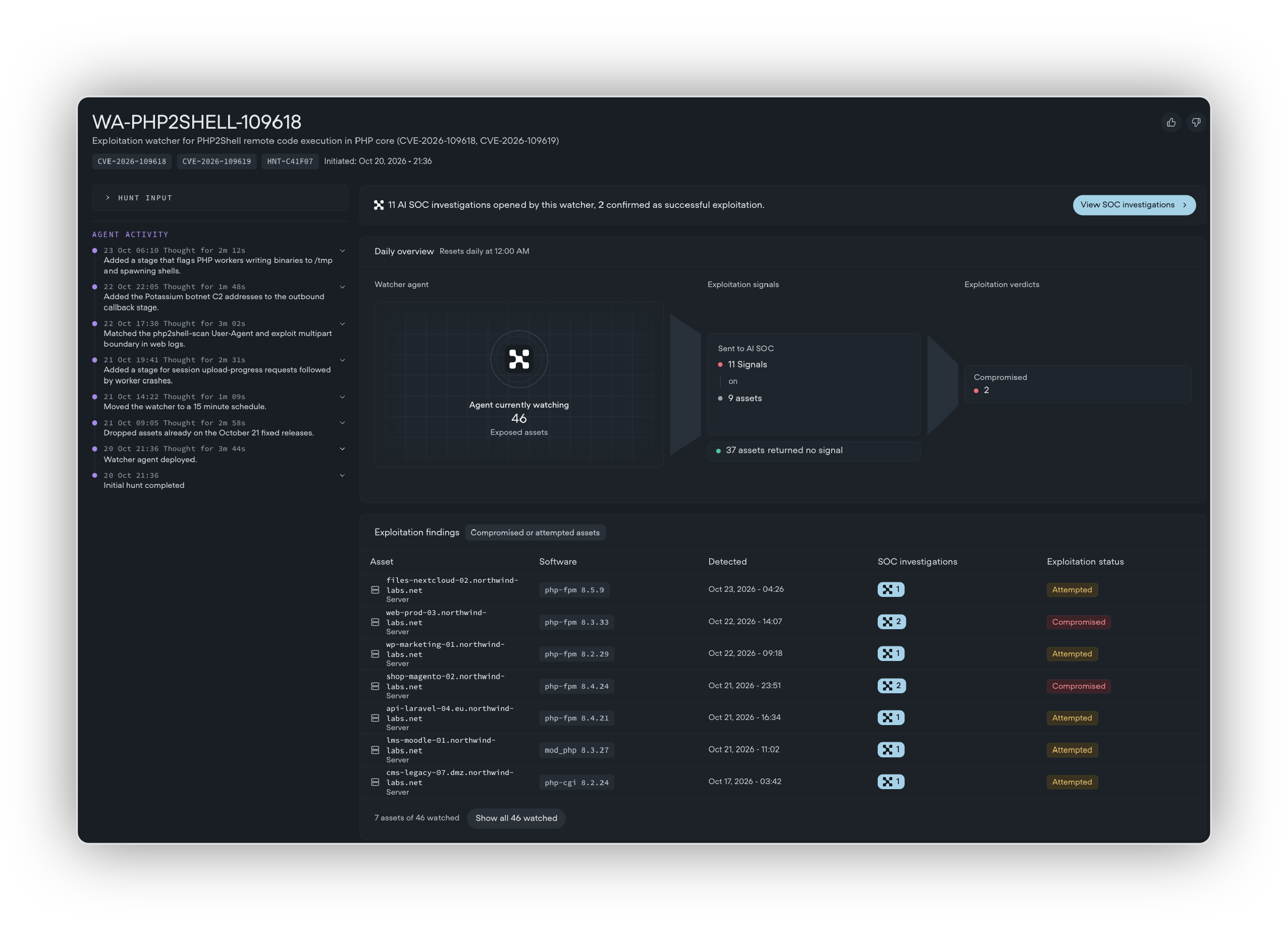
| 46 | Exposed assets under watch |
| 11 | Signals sent to SOC investigations, across 9 assets |
| 2 | Investigations confirmed successful exploitation |
| 37 | Assets returned no signal in the displayed overview |
The mission covered CVE-2026-109618 and CVE-2026-109619. The activity history runs from 20 to 23 October 2026. Customer identifiers have been anonymized.
The mission stayed in place. The detection changed.
The Watcher first completed a hunt and began monitoring the exposed workloads. As patches and threat intelligence became available, its scope and detection stages evolved.
Fixed assets were removed from the scope. The Watcher added searches connecting session upload-progress requests to worker crashes, matched new exploit indicators in web logs, incorporated command-and-control addresses and looked for PHP workers writing binaries and spawning shells.
| October 2026 | Recorded Watcher activity |
|---|---|
| 10-20 21:36 | Initial hunt completed |
| 10-20 21:36 | Watcher agent deployed |
| 10-21 09:05 | Dropped assets already on the October 21 fixed releases |
| 10-21 14:22 | Moved the watcher to a 15 minute schedule |
| 10-21 19:41 | Added a stage for session upload-progress requests followed by worker crashes |
| 10-22 17:30 | Matched the php2shell-scan User-Agent and exploit multipart boundary in web logs |
| 10-22 22:05 | Added the Potassium botnet C2 addresses to the outbound callback stage |
| 10-23 06:10 | Added a stage that flags PHP workers writing binaries to /tmp and spawning shells |
From a signal to a finding
The displayed overview records 11 signals across nine assets and 11 SOC investigations. Two investigations confirmed successful exploitation. The Watcher also distinguishes assets with exploitation signals from those that returned no signal in the overview.
These results describe this customer record. An absence of a signal is not proof that an asset has never been compromised. The investigation findings establish what the available evidence supports.
What this shows about Watchers
A Watcher keeps responsibility for a threat as the environment and the evidence change. Its detection logic can evolve with new research, updated intelligence and investigation findings. The mission continues while the customer works through the patching process.
Qevlar connects that monitoring to autonomous investigation, so the team can distinguish an exploitation signal from confirmed compromise and decide how to respond.
Read the full case brief
The accompanying brief covers the PHP2Shell exposure, the patching gap and the original Watcher dashboard.